
A teacher reviewing lesson plans at a laptop in a classroom

Why Teachers Should Not Run Away From AI

Some teachers are understandably worried about AI. Students may use it to write assignments, avoid reading, or produce answers they do not understand. AI can also provide false information and made-up citations.

These concerns are real, but completely banning AI may not solve them. Students may continue using it outside the classroom without learning how to recognize its weaknesses. Teachers have an opportunity to guide students before poor habits become normal.

AI Is Here to Stay

AI will likely remain part of education, employment, communication, and creative work. Students will need to understand how to work with it without becoming dependent on it.

Bușu argues that AI is here to stay and that it can become a teacher's co-worker when the teacher carefully reviews what it produces. AI may help create the structure of a lesson or activity, but the teacher must provide the judgment, knowledge, and human understanding that are missing (Bușu 36).

Teachers should not give up their role to technology. Instead, they should learn enough about AI to make informed decisions about when it is useful and when it gets in the way.

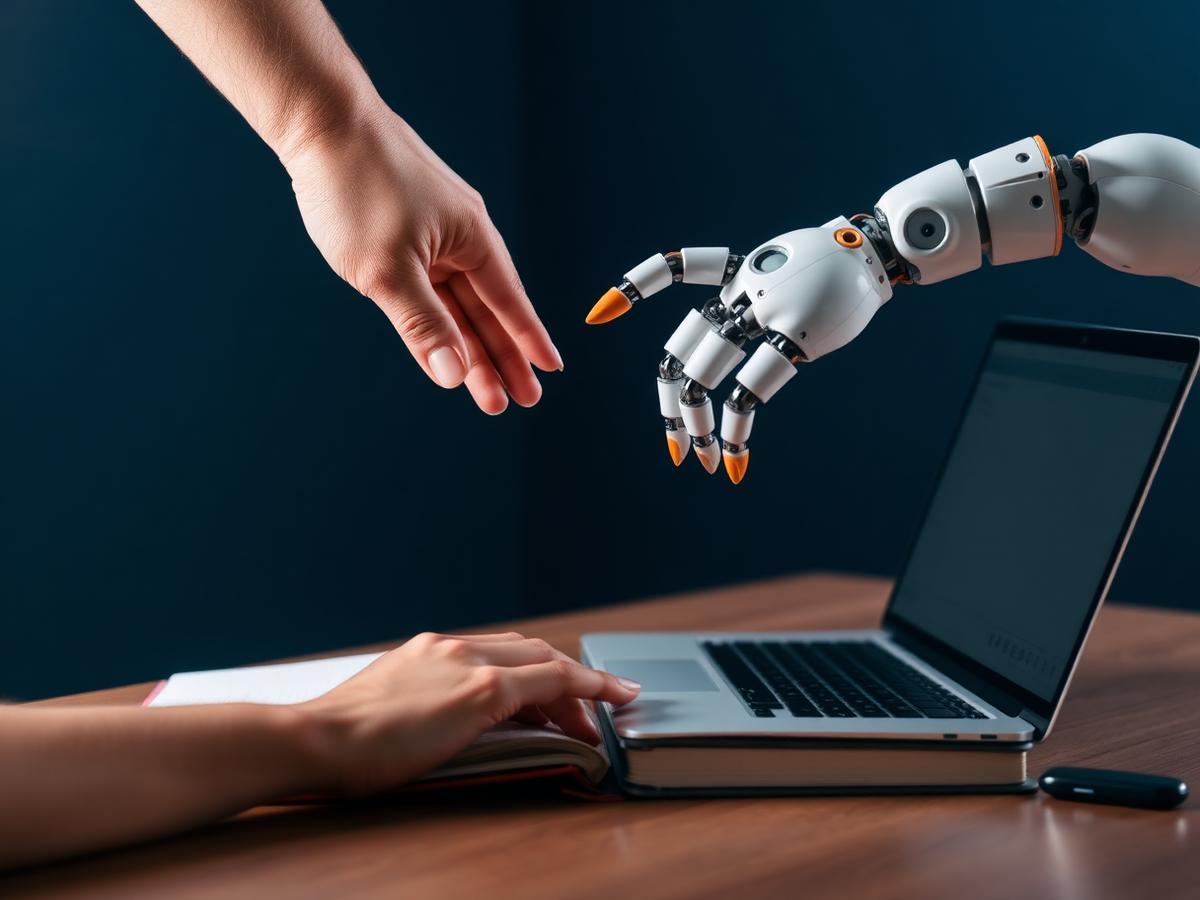
A human hand and a robotic hand reaching toward each other above a laptop and notebook

Students Need Guidance, Not Silence

Avoiding AI does not teach students how to use it responsibly. Students need opportunities to see that AI can give helpful answers while also making serious mistakes.

Joyce explains that AI tools can create information that is incomplete, inaccurate, or completely made up. Because of this, educators must use care when bringing AI into an academic setting (Joyce 187).

Joyce also describes using Cat-GPT, a playful AI tool that provides thoughtful answers with silly cat language and animations. The humor catches students' attention and allows the teacher to begin more serious discussions about the benefits, drawbacks, ethics, and common errors of AI tools (Joyce 188).

This type of lesson makes AI something students examine instead of something they secretly rely on.

AI Cannot Replace a Teacher

AI does not truly know the students in a classroom. It does not understand their personalities, backgrounds, emotions, strengths, or struggles in the way a teacher can.

A teacher can recognize when a student needs encouragement, a different explanation, more time, or a serious conversation. AI may generate information quickly, but education depends on relationships and human judgment.

Bușu explains that AI can support personalized and engaging learning, but human teachers are still needed to provide judgment and respond to students' emotional and individual needs (Bușu 37).

The purpose of using AI should be to give teachers more time for meaningful work with students. It should not remove the teacher from the learning process.

What AI Can Offer

AI can help teachers brainstorm activities, create practice examples, adjust materials, and develop discussion questions.

It can help students generate ideas, ask questions, receive basic feedback, and experiment with revision.

It may also help students who need additional language support or another explanation of a difficult idea.

What Teachers Must Watch

AI may provide inaccurate information, fake quotations, or citations that do not exist.

Students may become too dependent on it and lose confidence in their own writing.

AI-generated work may sound polished even when the student does not understand it.

Its responses may also contain biases based on the information used to train it.

Embracing AI Does Not Mean Trusting It Completely

Teachers can be open to AI while still remaining cautious. Responsible use means asking what the tool adds to the lesson and whether students are still doing meaningful intellectual work.

AI should assist the teacher and student, not take over their roles.